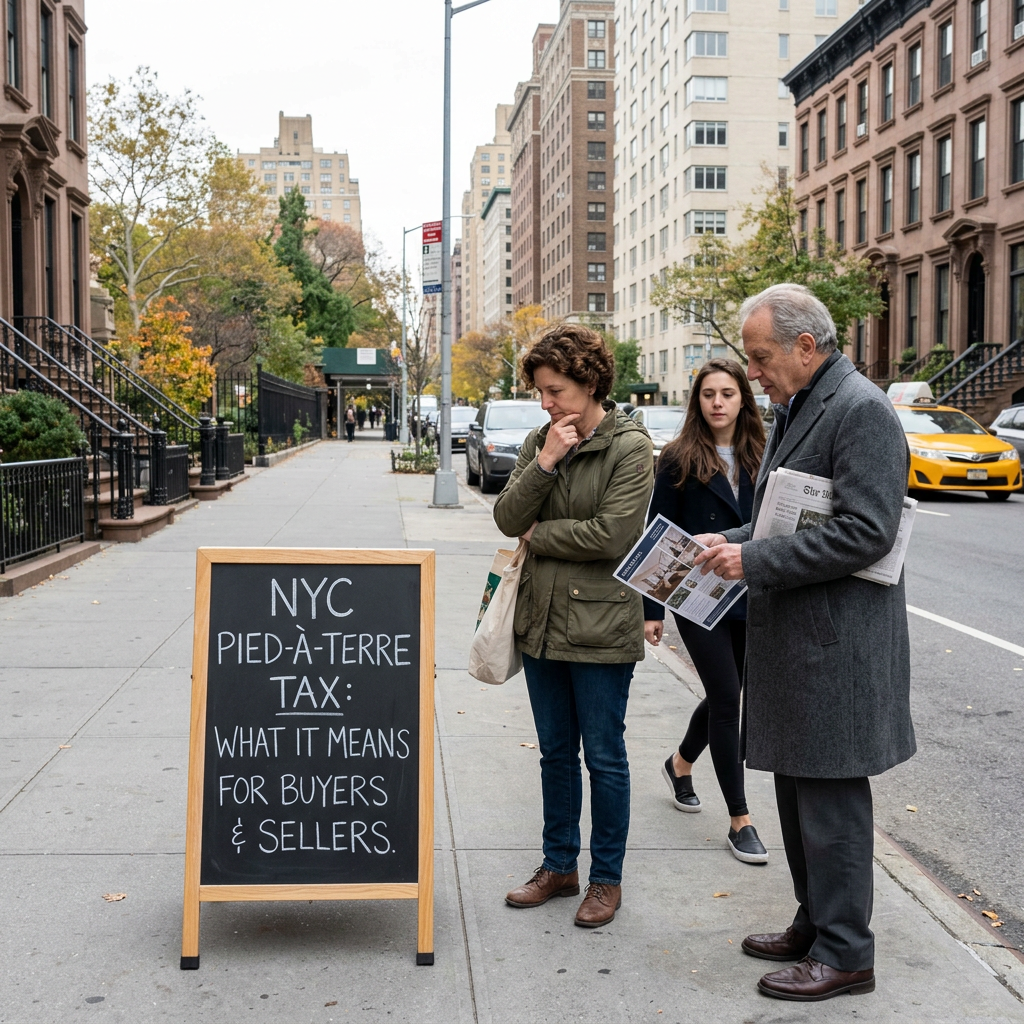
Caroline Bass, Licensed Associate Real Estate Broker at Corcoran, has discussed New York City’s pied a terre tax with the New York Post, Haven Lifestyles, and Bisnow.
Read the originals:
- Real estate insiders reveal the real cost of Mamdani’s pied-à-terre tax, and what it’s really doing to NYC, New York Post, August 2, 2026
- What Buyers and Sellers Can Expect From NYC’s Fall Housing Market, Haven Lifestyles, September 3, 2026
- How Mamdani’s Pied-à-Terre Tax Could Change NYC’s High-End Rental Market, Bisnow, November 5, 2026
What is the New York City pied a terre tax?
The pied a terre tax is an annual surcharge on New York City residences that are not the owner’s primary home. It was championed by Mayor Zohran Mamdani, signed into law by Governor Kathy Hochul in May 2026, and took effect on July 1, 2026. It is charged as a percentage of the property’s Department of Finance market value and sits on top of the regular property tax bill.
For the 2026-27 and 2027-28 tax years, the surcharge applies to condominium and cooperative units valued by the Department of Finance at $1 million or more, and to one-, two-, and three-family homes valued at more than $5 million.
For condo and co-op units, the rate is 4% of market value below $3 million, 5.25% from $3 million to under $5 million, and 6.5% at $5 million or more. For one-, two-, and three-family homes, the rate is 0.8% below $15 million, 1.05% from $15 million to under $25 million, and 1.3% at $25 million or more.
The deadline to apply for an exemption for the 2026-27 tax year was October 13, 2026. The surcharge appears on the property tax bill due January 1, 2027. Owners who disagree with the Department of Finance’s valuation, or whose exemption application was denied, can appeal to the New York City Tax Commission. Source: New York City Department of Finance, Non-primary residence surcharge.
City Hall projects the surcharge will raise roughly $500 million a year. The City Comptroller’s office projects a lower figure, in the range of $340 million to $380 million, once exemptions and behavior changes are accounted for.
In July 2026 the Department of Finance published a supplemental property roll and sent notices to owners it believed were affected. The roll was far broader than the notice list, which caused widespread confusion. Owners who received a notice must document their exemption or pay.
How is the surcharge changing the Manhattan market?
The surcharge narrows the buyer pool for apartments that will be held as second homes, and it does so at the exact price points where second home demand has historically been strongest. That has two practical effects.
First, pricing accuracy matters more than it did a year ago. An apartment that will read as a pied a terre to most of its likely buyers now carries a known annual cost that did not exist in the comparable sales. Pricing off those comparables without adjusting for it is how a listing sits.
Second, the exemption question has become part of the transaction. Buyers are asking earlier whether a building’s ownership profile is heavy on non primary residences, because that shapes who they will be competing against and who they will eventually sell to.
In Haven Lifestyles’ September 2026 look at the fall market, I said the surcharge could prompt some owners to sell sooner than planned. For an owner already weighing a sale, a new annual carrying cost changes the math on waiting. For my read on which Manhattan neighborhoods should hold up this fall, see this fall’s neighborhood outlook.
Does the surcharge follow the apartment when it sells?
In some cases, yes. The surcharge is billed and enforced the same way as real property taxes, and the law allows liens for unpaid amounts. An unpaid surcharge attached to a property can remain with that property after a sale, which means a buyer can inherit a bill they did not create.
Any buyer looking at an apartment that could fall under the definition should have their attorney confirm the surcharge status in writing before signing a contract. This is a due diligence item now, the same way a capital assessment or a flip tax is.
Does the surcharge apply if the apartment is rented out?
Not when the tenant lives there as their primary residence. The Department of Finance exempts a unit that is the primary residence of a tenant or subtenant. A unit leased to someone who uses it as a second home does not meet that test.
Proving it falls to the owner. The Department of Finance asks for proof of the tenant’s primary residence, such as a tax return or a driver’s license. It also asks for the current lease plus one additional rental document, or a tenant or subtenant affidavit with two additional rental documents. For the 2026-27 tax year, that application was due October 13, 2026.
Owners are already changing how they lease. In Bisnow’s November 2026 look at the high end rental market, I noted that landlords have begun adding lease riders. The riders require the tenant to use the home as a primary residence.
“I don’t think New York City is the place where people roll over and just say ‘OK, I’m going to give you my money.’”
Caroline Bass, quoted in Bisnow, November 5, 2026
The owners of these apartments are sophisticated, and they have people in place to protect their money. Some may sell sooner than planned, as I told Haven Lifestyles in September. Others are protecting the exemption through their leases.
What Manhattan owners should do now
If you received a notice from the Department of Finance and the apartment is your primary residence, respond with documentation rather than waiting. The burden of proof sits with the owner.
If you are considering selling a non primary residence, price it against what buyers will actually owe to hold it, not against what comparable apartments sold for before July 2026.
If you are buying, ask the question during due diligence. Confirm the surcharge status of the specific unit and understand how the building’s ownership mix could affect resale.
I also explained the surcharge in a short Reel that reached owners well beyond my usual audience. Here is why I make Manhattan real estate videos.
The surcharge changes the math on holding a second home in New York City. It does not change what makes an apartment sell. Accurate pricing, clean presentation, and a buyer who understands the full carrying cost before they bid are what move a listing in this market.
Working with a Manhattan seller’s agent